Even if your story is completely made up, from the world it takes place in, to the types of characters and beings, fiction writers have to do research. They have to know that certain things- like the laws of physics and how they apply throughout the universe. Having a work of fiction based on real world- what we know to be true- rules helps ground the story giving it believability. Take for instance, the movie, The Martian, one of my fave sci fi movies. There is so much science and fact that the movie is believable.
Whoa, Hold On There!
That doesn’t mean that everything is true or even possible. According to movie reviewer Jeffrey Kluger of Time Magazine, the dust storm which isolates Mark Watney on the planet are simply not possible because “Dust storms on Mars cannot get strong enough to cause those kinds of problems.” Think a puff of wind versus a hurricane, because of the thin atmosphere. That’s a major plot point because it causes the incident that the story revolves around. But… most people don’t know that so it worked out, although I’m sure scientists at NASA and JPL were all snickering behind their hands watching the movie. Unless you’re very scientifically aware, that detail didn’t even register for most of us.
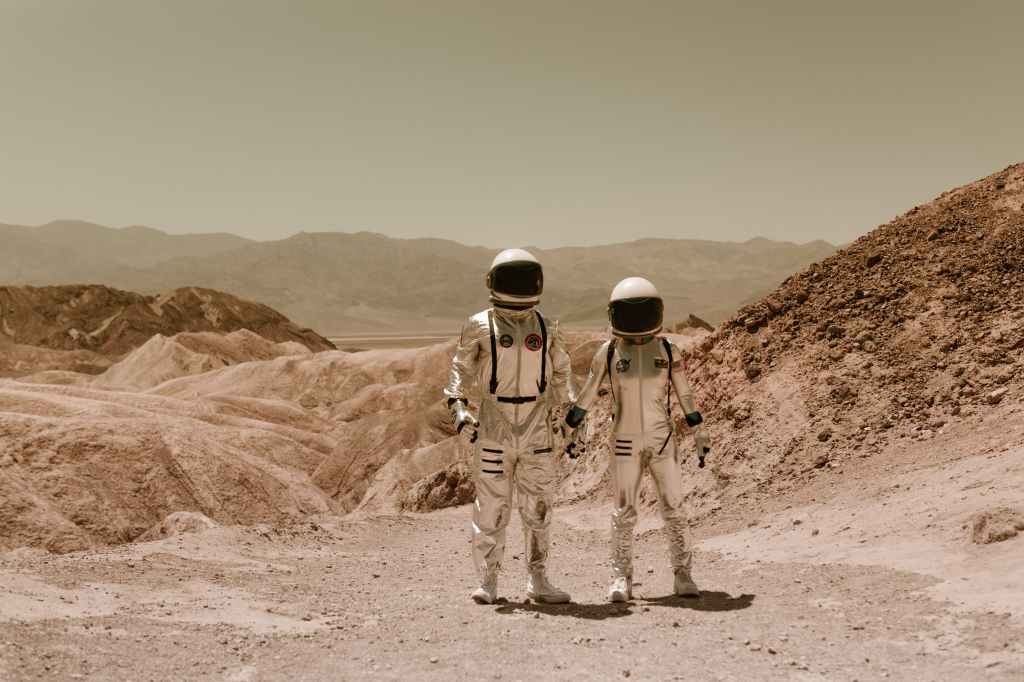
Photo by RDNE Stock project: https://www.pexels.com/photo/astronauts-in-spacesuits-standing-and-holding-hands-8474476/
Sometimes, The Impossible Is Okay
Consider the various Star Trek series. A lot of what was envisioned, like communicators which are nothing more than cell phones, has come to pass. One thing that can never exist is the transporter system. It is impossible to descramble a living creature into molecules or atoms, beam it across space, and reassemble with no ill effects. (I’ve written about this in a previous blog post.) Not happening. However, it’s come to be acceptable because frankly, we wanted to believe, we assumed (back in the 60s when Star Trek first came out) that we could eventually achieve it, or, we simply disregarded the impossibility. Look at works like Harry Potter or Frankenstein– it’s just not happening. In a way, though, parts of Frankenstein have come to pass: we donate organs from those who are kept alive only by machines; in practicality, they are dead. The harvesting of organs creates a new or better life for others in fatal situations. Back when Mary Shelley wrote her novel, scientific exploration was expanding. Many believe the inspiration for her novel came from scientists watching the effects of electrical charges; a jolt to a frog’s leg made it jump. Of course, today we realize you can’t create a person from dead bodies, unless it’s from cloning cells from a body (and I don’t know if that’s possible).

Photo by Ahmed Adly: https://www.pexels.com/photo/grayscale-photography-of-human-skull-1270184/
If You Completely Ignore The Research…
Then you run the risk of the story falling apart at some point. Magic, like in any fantasy story, has a lot of leeway, because, well, magic. Science fiction, paranormal, and other speculative fiction need some basis of fact. For example, a steam-powered spaceship, most people know, is not possible because space does not have oxygen to support steam engines on a trip out of our atmosphere (and everyone would die). However, it works for airships that travel in our atmosphere. It’s not practicable to actually build such a ship, but hey, it’s fun reading and falls under “what if we could….”
I recently read a series, and while I like the author’s style and story, several things have put me off:
- The story is set in 1816 and the main character calls a villainess a ‘vampire queen’. Bram Stoker did not write Dracula until 1897. Until then, vampire lore was not well known, being confined to remote areas in Slavic parts of the world, i.e. Romania, Poland. I’m a fan of the classic horrors, so I knew this. Most may not and it could pass, but…
- The author talks about a cannon-like weapon, a Howitzer. Yes, Howitzers were used as early as the 17th century, according to Howitzer | Military Wiki | Fandom (this isn’t a scholarly paper, so I’m being a little lax and quoting Wikipedia.) However, the Howitzers in the story were large, heavy, and cumbersome. They needed to be pulled by horses. The author describes the Howitzers, in pieces, being crated up and transported by rowboat to a larger ship. The weight of large, heavy cannons would sink a rowboat. If the guns were wheeled across a dock, then lifted by pulley system onto the larger ship, that would have been more believable, but it was more dramatic rowing the canons out to a ship waiting offshore.
- The author mentions that there was a “winter in summer”, referring to the explosion of a volcano, Mount Tambora in 1815. The ash spewed into the air caused a world-wide winter. Yes, that’s accurate. Pliny the Younger in 79 A.D. wrote about the eruption of Mount Vesuvius and thus the science of volcanology was created, says Joe Chandler in “The History of Volcanology”. But, the effects of the Mount Tamborra eruption was not studied until “a century later”, according to Chandler, so the characters could not have known about the atmospheric consequences.

Photo by Suhairy Tri Yadhi: https://www.pexels.com/photo/erupting-volcano-under-blue-sunny-cloudy-sky-1058633/
Okay, Maybe It’s Overkill
Most people are happy to skip over inconsistencies and inaccuracies, but sometimes, it trips up a reader. Now, I’ll read this author’s other books in the series because I want to see the resolution of the story, but I won’t enjoy it as much. Each reader has to decide at what point they can’t continue on. These were minor flaws, but I believe in doing research, especially in connection to historical perspectives because we know so much more today, whether through education or even assimilation through media, that those in the past could not have known.
Sources:
- Chandler, Joe. “The History of Volcanology.” -https://sciencing.com/history-volcanology-5397406.html. (Accessed 03 Feb. 2024).
- Kluger, Jeffrey. “What The Martian Gets Right (And Wrong) About Science. 18 May, 2016. https://time.com/4055413/martian-movie-review-science-acccuracy-matt-damon/.
- “Military History”. Wikipedia, Nov. 2014. https://military-history.fandom.comm/wiki/Howitzer.
 Charlotte Bennardo
Leave a comment