I finished my MFA (with English Honors, if I may brag). That means back to the business of writing. I’m working on several novels; some will be sent to editors and agents, some will be independently published. And, I’m bringing back my blog on this website. Soon I hope to enhance my website with added features. So stick around, come back, share with others. Thanks!
We’re Made of Stars…But Not Born in Them

Photo by Lalit Arora: https://www.pexels.com/photo/silhouette-of-a-man-kissing-the-tummy-of-a-pregnant-woman-13579209/
They fled Earth when its resources ran out, steering their colony ship to the stars and beyond. The first baby born in space was named Adam…
Babies…In Space?
Nope. That’s not how it’s going to be. At this point, out technology isn’t advanced enough to allow for babies to be conceived or born or survive in space. The main reason says Harsh Gupta in his article, “Can Babies Be Born In Space?” is gravity. Beginning with conception, Gupta says that not only the mechanics of sexual intercourse in weightlessness (hey, astronauts are tethered down to sleep in space so they don’t float away!) but “human sperm cells need gravity for migration to the egg.” Gupta says this makes fertilization “even more difficult.” And, he adds, even if fertilization occurs, “it is more difficult for the embryo to mature into a baby without the proper flow of fluids from the mother’s body to the embryo” which requires gravity.
Stop the Space Ship, I’m Going to Be Sick
Then, there’s the issue of motion sickness which is affected by zero gravity; “because inner ear fluids which affect perception of balance” come into play, says Gupta. And without gravity, “individuals born there [in space] would develop bloated bodies and puffy faces, the heart would…atrophy because it doesn’t have to pump blood against gravity and blood content would decrease causing paleness and weakness.” Wait, it gets better; “our eyes would bulge and our brains would lose efficiency.” The picture Gupta presents is not pretty. What parents would want that for their child?
Sunblock- 2 Million SPF, Please
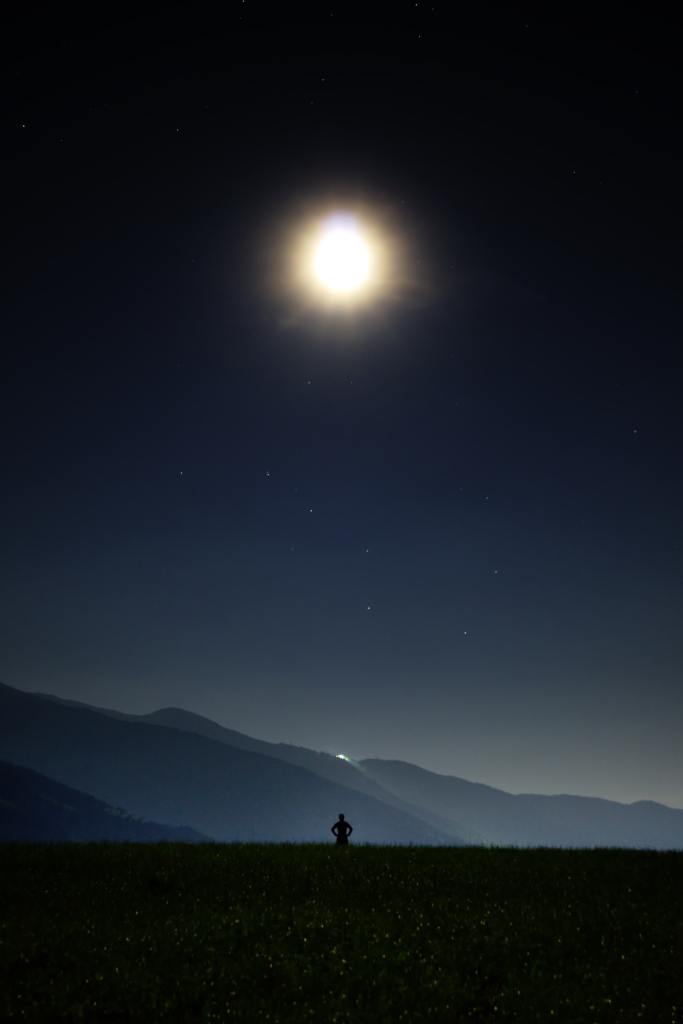
Photo by Pixabay: https://www.pexels.com/photo/silhouette-of-person-in-green-grass-under-the-sun-during-daytime-33696/
Let’s not forget solar radiation which causes a host of health issues like “increased probability of Alzheimer’s, degradation of the immune system, and fewer white blood cells. Wait, it gets worse! (Really, as if all that wasn’t enough to encourage you to be a monk while on space missions) Skeletal ad muscular deformities occur because without the stress of gravity making muscles work, there is a loss of muscle and bone mass, and this is especially problematic in developing children. That’s why any footage of astronauts in a good sci fi flick (think “The Martian by Andy Weir) or even from the International Space Station shows the astronauts doing physical activities. Finally, (yes, more bad news) space travel is the ultimate in isolation, causing “cabin fever” which results in depression and declining mental health so few would even think about a romance in the stars.
Let’s Colonize Mars! (Or Any Planet!)
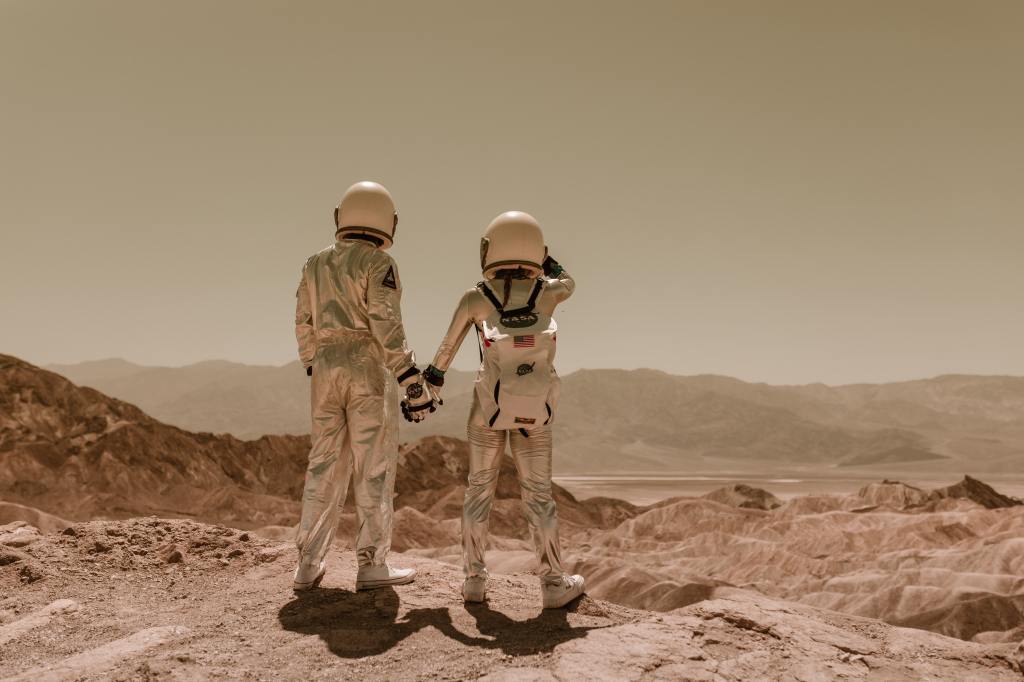
Photo by RDNE Stock project: https://www.pexels.com/photo/back-view-of-astronauts-holding-hands-8474487/
Okay, babies born in space are out. What about babies born on Mars? We’re planning to land and colonize that planet eventually (or the moon). Well, again, radiation is a big threat, says JR Minkel in his article “Sex and Pregnancy on Mars: A Risky Proposition.” Before astronauts even get to space, “high-energy particles bombarding the ship would almost certainly sterilize any female fetus conceived in space”, so that pretty much ends the discussion of generations on Mars. While scientists are working on shielding against solar radiation, the bigger problem, writes Minkel, is “radiation streaming in from outside the solar system: charged particles “can blow apart biological molecules such as DNA.” Human egg cells are too vulnerable. Another danger, says Minkel, occurs when cells divide in a fertilized egg. Damage to a single cell would create a larger developmental problem if that cell “was destined to become the brain or another organ.” Let’s not leave the guys out of this—sperm cells can be damaged contributing to birth defects or male sterility.
There is No Booty Call in Space
Well, technically. NASA has strict protocols of no intimacy in space and so far, no married couple has been in space together to test the theory out that sex in space could be fun, or let alone even possible. When Miriam Kramer interviewed Athena Andreadis, a biologist at the University of Massachusetts Medical School, Andreadis said “You have no traction and you keep bumping against the walls” in zero gravity. “You have no friction, no resistance.” Think back to physics class: a body in motion stays in motion until an outside force acts upon it. Let’s get down to the gross. Sex is messy with the release of body fluids, and that, says Katherine Gammon in “Can You Get Pregnant is Space?” causes problems for the ship’s electronics. The last insult? Weightlessness interferes with blood pressure, affecting a male’s erection.
Earthbound

Photo by Jaymantri: https://www.pexels.com/photo/blue-and-gray-moon-during-nighttime-5439/
So for now, there will be no lovey dovey or babies in space, on the moon, or Mars until scientists can address these difficulties. As science fiction writers, we have to be aware of these impediments and not ignore them but be creative enough to make these a non-issue, like imagining technology that overcomes them or incorporating real world advancements as they develop.
Sources:
Gupta, Harsh. “Can Babies Be Born In Space?” 18 Sep. 2022. https://www.scienceabc.com/nature/universe/can-babies-be-born-in-space.html.
Gammon, Katharine. “Can You Get Pregnant in Space?” 17 Feb. 2011. https://www.livescience.com/33047-space-sex-pregnancies.html.
Kramer, Miriam. “Sex in Space Could Be Out of This World…Or Not.” 18 Apr. 2013. https://news.yahoo.com/sex-space-could-world-not-090749218.html
Minkel, JR. “Sex and Pregnancy on Mars: A Risky Proposition.” 11 Feb. 2011. https://www.space.comm/10822-sex-mars-pregnancy-space-risks.html.
 Charlotte Bennardo
Leave a comment